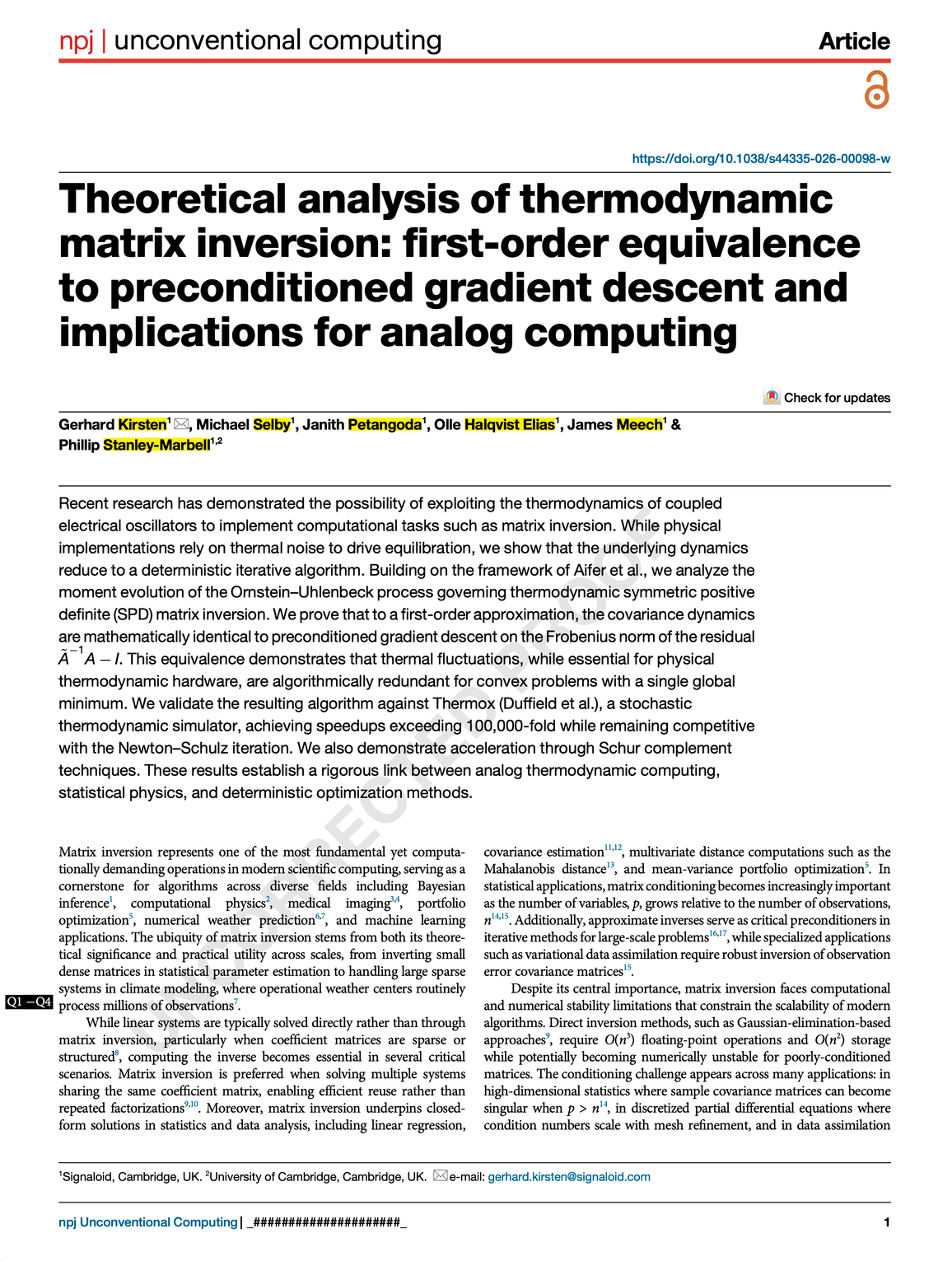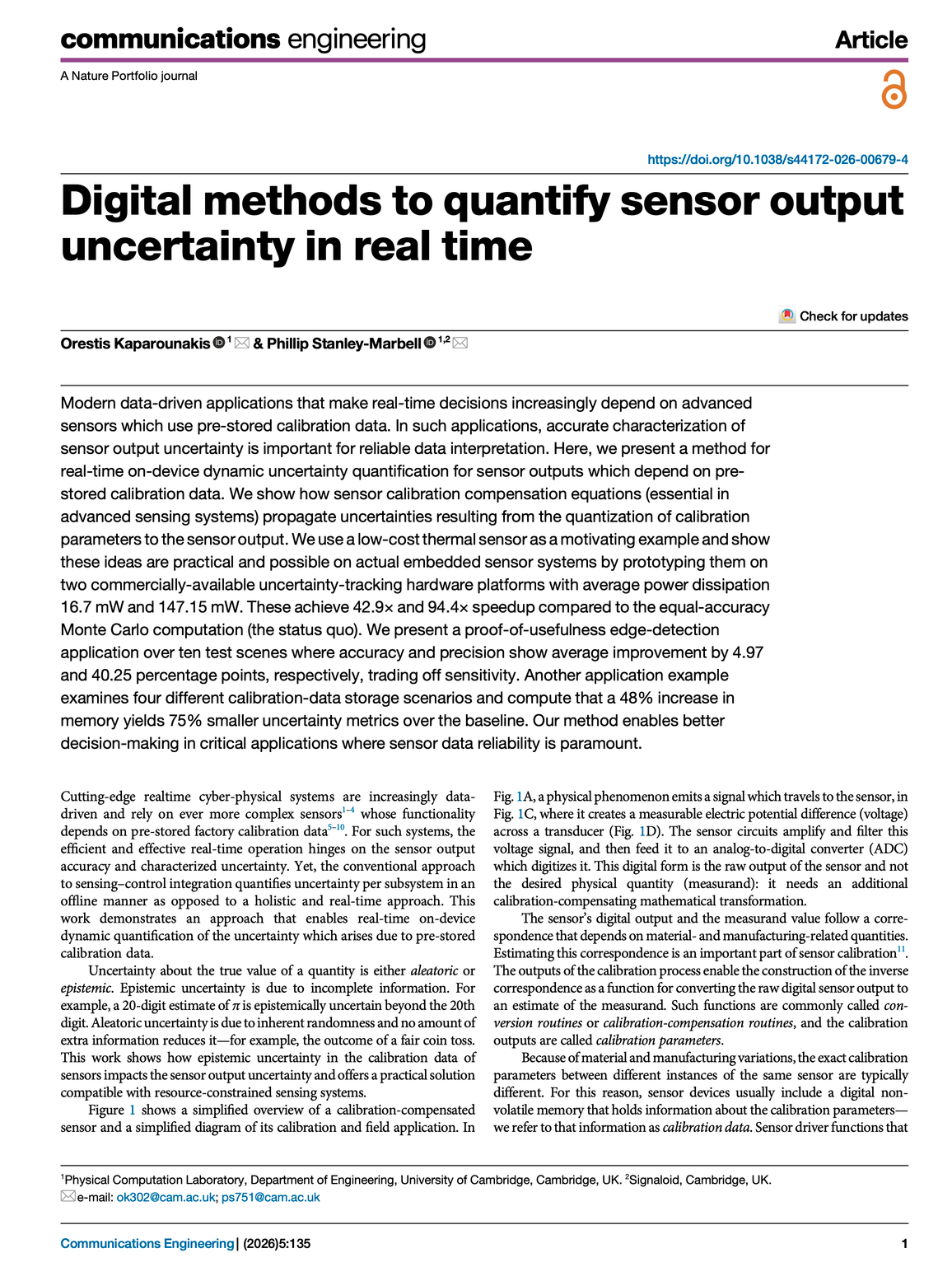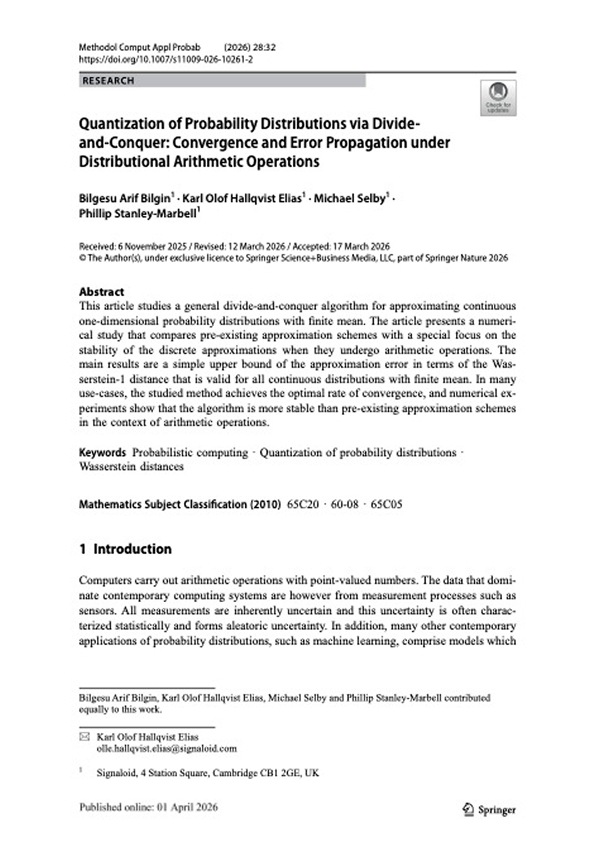
The Monte Carlo Method and New Device and Architectural Techniques for Accelerating It

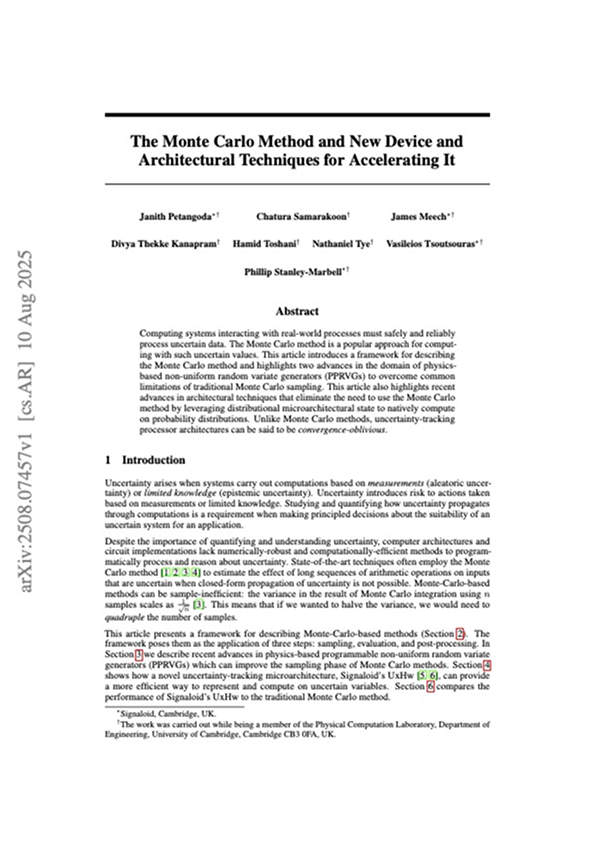
J. Petangoda, C. Samarakoon, J. Meech, D. T. Kanapram, H. Toshani, N. Tye, V. Tsoutsouras, P. Stanley-Marbell, 10 August 2025
Abstract
Computing systems interacting with real-world processes must safely and reliably process uncertain data. The Monte Carlo method is a popular approach for computing with such uncertain values. This article introduces a framework for describing the Monte Carlo method and highlights two advances in the domain of physics-based non-uniform random variate generators (PPRVGs) to overcome common limitations of traditional Monte Carlo sampling. This article also highlights recent advances in architectural techniques that eliminate the need to use the Monte Carlo method by leveraging distributional microarchitectural state to natively compute on probability distributions. Unlike Monte Carlo methods, uncertainty-tracking processor architectures can be said to be convergence-oblivious.
Cite as:
Petangoda, Janith, Chatura Samarakoon, James Meech, Divya Thekke Kanapram, Hamid Toshani, Nathaniel Tye, Vasileios Tsoutsouras, and Phillip Stanley-Marbell. "The Monte Carlo Method and New Device and Architectural Techniques for Accelerating It." arXiv preprint arXiv:2508.07457 (2025).
Bibtex:
@article{petangoda2025monte,
  title={The Monte Carlo Method and New Device and Architectural Techniques for Accelerating It},
  author={Petangoda, Janith and Samarakoon, Chatura and Meech, James and Kanapram, Divya Thekke and Toshani, Hamid and Tye, Nathaniel and Tsoutsouras, Vasileios and Stanley-Marbell, Phillip},
  journal={arXiv preprint arXiv:2508.07457},
  year={2025}
}